


Have you ever thought that making tires could be done in a smarter way? Many factories still use old methods, but new machines now work with steady precision and give updates in real time.
Sensors (small devices that quickly spot problems) and simple AI team up to catch little issues before they grow. This means every tire is made right, much like feeling the gentle hum of your engine on an easy drive.
Switching to smart production cuts down on waste and speeds up the process without lowering quality. So, tire automation isn’t just a small upgrade, it’s a whole new way to build tires that are as tough and reliable as the grip of your car on a rainy day.
Efficiency and Quality Benefits of Automation in Tire Manufacturing

Back in the day, manual work and old equipment meant high costs, long cycle times, and inconsistent output. Now, machines do the work with steady precision and fairness, making the whole process smoother and more reliable. Automated quality control uses sensors, cameras, and simple AI checks to spot issues like sidewall problems, tread wear (how quickly a tire’s surface erodes), or even hidden damage inside, all in real time. Imagine an AI catching a small tread flaw that a person might easily miss, that’s the modern way to inspect tires.
Automation not only lowers defect rates and trims down waste, but it also makes timely checks possible so that adjustments happen right away. This smart system keeps tabs on each production step, fixing small issues before they become bigger hassles.
Key benefits in simple terms include:
| Benefit | Why It Matters |
|---|---|
| Consistent Quality | Machines work precisely, so every tire is made to the same high standard. |
| Less Waste | Using the right materials means lower production costs and less scrap. |
| Faster Production | Quick cycle times boost output while keeping quality high. |
| Less Manual Labor | Machines take over routine tasks, allowing people to focus on monitoring and improving processes. |
Big names like Michelin, Kama Tyres, Linglong Tire, and Cooper Tire are already using these smart systems, and they’re seeing much better production rates. With the global market for tire automation expected to grow 3–4% by 2022, it’s clear that the industry is shifting from old-school methods to a smarter, more reliable way of making tires.
Key Automation Technologies Driving Tire Manufacturing Innovation
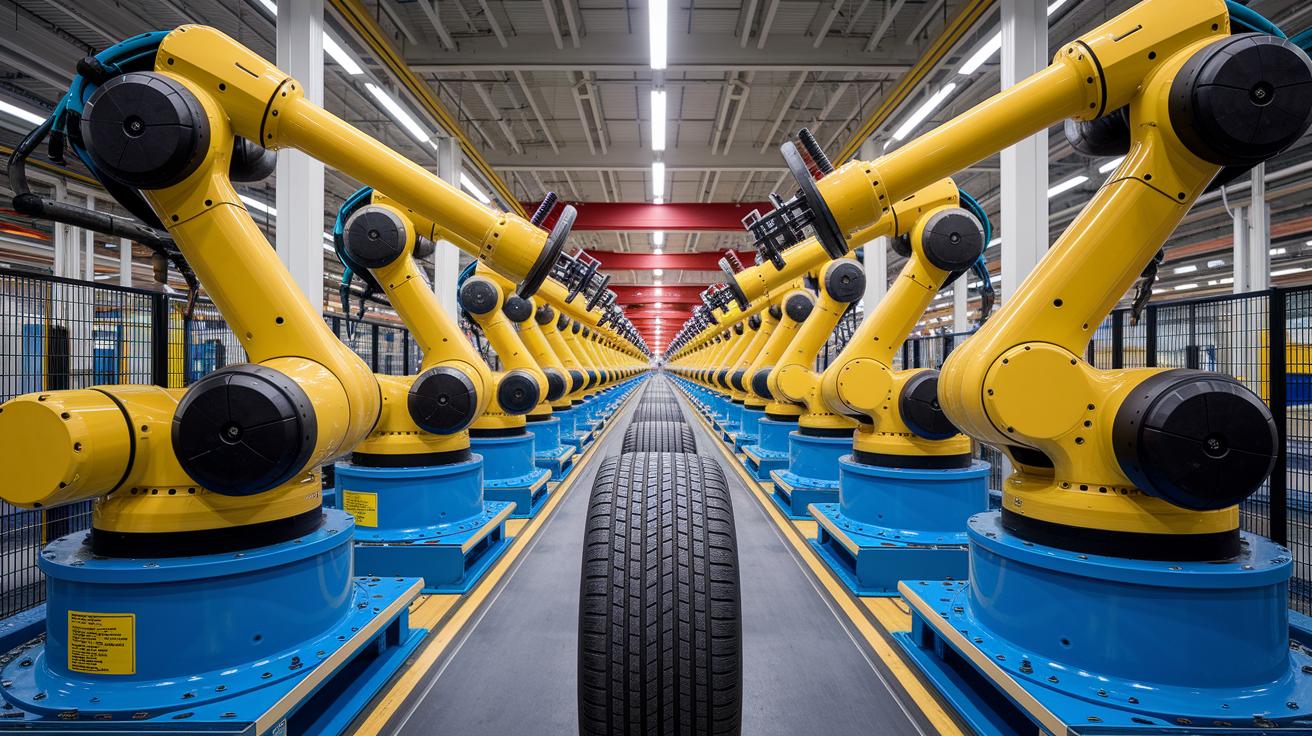
Robotics in Tire Production
Today’s tire plants lean on smart robots to take care of many tasks. These machines handle jobs like sanding, removing rough edges, flame treatment, putting on adhesive, spray coating, and assembly. Imagine them as trusty mechanics making sure every tire is just right. Models like the RTS2000i, RTS1000i, and others in the ARC Mate, Collaborative Series, and M-Series families are hard at work every day, much like a favorite pit crew giving your ride the perfect tune-up.
AI-Based Quality Control
Modern tire factories also use AI to check the quality of each tire. These smart systems use image recognition and deep-learning (a type of computer learning) to spot problems such as sidewall defects, tread inconsistencies (how quickly the tire’s surface erodes), and even hidden flaws. Picture a machine catching a tiny blemish that might have gone unnoticed. It’s like having an extra set of eyes that never tire, ensuring that every tire meets high standards.
Sensor and IoT Integration
Sensors and IoT (Internet of Things) technology are another game changer on the production line. They send live data back to the operators, helping them tweak curing ovens, belt speeds, and how compound mixes. Think of sensors as a dashboard that gives real-time updates, letting workers know when a small change is needed. With this setup, potential issues are caught early, keeping the production smooth and efficient, almost like having a built-in system for avoiding bumps in the road.
Implementation Strategies for Automation in Tire Production

Switching from making tires by hand to using an assembly line can feel like embarking on a new road trip. Start with a close look at your current system. Think of it as checking your car before a long drive, make sure everything is in good shape so you know what needs a tune-up. Then, try a small test run. This gives you a chance to see how smart software can help control mixing, setting conveyor speeds, and managing baking (curing cycles) before you go all in.
Every great plan has a roadmap. Here’s a simple breakdown:
| Step | Description |
|---|---|
| Needs Assessment | Check your current production and spot areas for improvement. |
| Pilot Deployment | Run a small test to smooth out the kinks in the new system. |
| Full-Scale Rollout | Gradually introduce automation to all sections of production. |
| Operator Training | Teach your team how to manage and maintain the new tech. |
Working with a turnkey solution provider is like having a trustworthy mechanic on standby. They handle everything from designing the system and programming the control units (PLC integration) to installing the hardware and training your staff. This way, the switch feels less like a leap into the unknown and more like a smooth ride.
Another key upgrade is using predictive maintenance. Picture this: software that helps foresee wear and tear so you can fix problems before they pop up. And by letting machines take care of tasks like mixing rubber or managing inventory, your whole system drives forward without hiccups.
With careful planning and these smart moves, your tire production line can become as reliable and smooth as your favorite well-tuned ride.
Case Studies on Automating Tire Production Lines

The tire industry is changing fast thanks to automation. Companies are using smart tech to speed up production and keep quality high. It’s like giving a tire plant a few extra hands that never get tired. I love seeing how simple changes can make such a big difference.
Take the P250 Rail Robot Replacement for example. Upgrading the sanding cell cut cycle times by 25%. At a Michelin facility, new mold handling methods and curing ovens bumped production up by 30%. Cooper Tire used DTS1000i deflashing robots, which meant 30% fewer workers and a 15% drop in scrap rates. And Kama Tyres used AI inspection systems with sensor networks, cutting defect escapes by 25%.
These real-world examples show that smart automation really works. When you invest in the right technology, you make production smoother and more reliable. I mean, who wouldn’t want a system that keeps things steady, like the soft purr of a well-tuned engine?
| Company | Automation Solutions | Performance Improvements |
|---|---|---|
| P250 Rail | Sanding cell upgrade | Cycle times reduced by 25% |
| Michelin | Automated mold handling and curing ovens | Throughput increased by 30% |
| Cooper Tire | DTS1000i deflashing robots | Labor headcount down 30%, scrap rates down 15% |
| Kama Tyres | AI inspection systems and sensor networks | Defect escapes reduced by 25% |
These stories show that when good tech meets tire production, things really improve. Smart automation gives you steady, quality results, just like that smooth drive after a long day.
Cost-Benefit Analysis of Automation in Tire Manufacturing

Investing in robotic workstations usually runs between $150,000 and $300,000. It might sound like a lot, but these systems often pay for themselves in just 2 to 4 years through savings on labor and better production yields. For example, Cooper Tire managed to cut scrap waste by 15% and slashed labor costs by 20%, clearly showing how smart automation can be.
Using predictive maintenance, basically keeping an eye on your machines to catch problems early, can reduce unexpected downtime by about 30%. This means production keeps moving with the smooth, steady hum of a well-oiled machine. Plus, energy-saving measures, like automated curing ovens and tuned belt speeds, can trim utility bills by roughly 10%.
All these changes add up. They result in steady production rates, consistent quality, and less need for rework, which means the overall cost of owning and running the system goes down over time. Manufacturers turn big fixed costs into manageable investments, enjoying improvements in both robotics cost efficiency and manufacturing performance.
On top of that, automated systems collect valuable data, letting companies tweak operations before issues even arise. Over the long haul, automation isn’t just about spending money, it’s a real investment that boosts durability, gives a competitive edge, and delivers measurable financial returns. It’s clear why many tire makers now see automation as a smart, sustainable way to grow their business.
Future Trends and Innovations in Tire Manufacturing Automation

In a fully digitized cell, throughput can soar by 20%, making every tire roll off the line with unparalleled consistency.
Imagine being able to fine-tune your production process without touching the equipment. That’s exactly what digital twin simulation does. It lets manufacturers run a virtual test on changes to the production line, sort of like rehearsing a play before the big show. Plus, with the rise of predictive analytics and machine learning, maintenance has become way smarter. These tools help set up flexible maintenance plans and spot any issues as soon as they pop up, keeping downtime to a bare minimum.
Then there are collaborative robots, or cobots, that are quickly finding their place next to human workers on the shop floor. Picture a setup where people and robots work side-by-side, each excelling at what they do best. These cobots make it easy to rearrange tasks and adapt to new challenges, just like a team that’s always ready for a pit stop. Energy monitoring systems also play a big role by tracking how much power is used in real time, which helps optimize the entire production process.
And with remote monitoring and smart AI systems, tire plants can now keep an eye on everything around the clock. Any small deviation from the norm gets flagged immediately so that issues can be sorted out quickly. The blend of digital factory integration and smart manufacturing tools isn’t just a peek into the future, it’s already reshaping how tires are made today, making the whole process more responsive and efficient.
Final Words
In the action of shifting from old manual methods to advanced solutions, this article walked through how tools like real-time monitoring systems and sensor-based controls boost both production speed and tire quality. We saw how robotics and AI-based quality checks create smoother workflows and reduce defects, all while keeping cost savings in view.
The tech upgrades not only improve manufacturing efficiency but also help maintain high performance at every mile. Embracing automation in tire manufacturing leads to a safer and more reliable ride.
FAQ
What are the biggest innovations in tire technology?
The biggest innovations in tire technology include advanced automation and smart quality control systems. They use robotics, real-time sensors (for sidewall and tread checks), and AI-driven adjustments to boost consistency and reduce waste.
What are the types of automation used in manufacturing and how is it used?
Automation in manufacturing employs robotics for assembly, AI-based quality control to spot defects, sensor systems, and connected devices that adjust processes in real time, resulting in a more reliable and efficient production line.
What is the manufacturing process of tires?
The manufacturing process of tires starts with mixing raw materials and building layers, then shaping, curing in ovens, and thorough inspection. Automation enhances each step by ensuring precision, reducing waste, and speeding up production.

